What is a scratch test?
The scratch test is the reference method for assessing how well a coating adheres to its substrate and how well it resists scratching. Fast, repeatable and standardised, it is used both in research and in quality control, for PVD, CVD and DLC hard coatings as well as for thin films, paints and polymers. Here is how it works, what it measures and how to choose the right scratch tester for your coatings.

Why measure coating adhesion?
A coating can be hard, thick and perfectly uniform, and still peel off at the first mechanical stress. Poor adhesion ruins the properties of the deposit: a cutting tool loses its protection, a mechanical part wears prematurely, an optical lens gets scratched. Measuring adhesion makes it possible to validate a deposition process, compare surface preparations, optimise the thickness of a layer or check the consistency of a production run.
The principle of the scratch test
A diamond stylus, usually a Rockwell C type with a 200 µm tip radius, is pressed onto the coated surface with a normal force. The sample moves at constant speed under the stylus, which draws a scratch. The load can be constant or, more often, progressive: it increases gradually along the scratch, from a very low value up to the chosen maximum load.
As the load increases, the stresses in the coating build up until they cause characteristic damage: cracks, chipping, then removal of the layer. After the test, the scratch is examined under an optical microscope to locate each type of damage precisely and relate it to the load applied at that point.
Critical loads Lc1, Lc2 and Lc3
The result of a scratch test is expressed as critical loads, the loads at which given types of damage appear. The most commonly used are:
- Lc1: first cracks in the coating (cohesive failure);
- Lc2: first chipping at the edges or bottom of the scratch, indicating a loss of adhesion (adhesive failure);
- Lc3: extensive delamination, with the substrate exposed across the full width of the scratch.
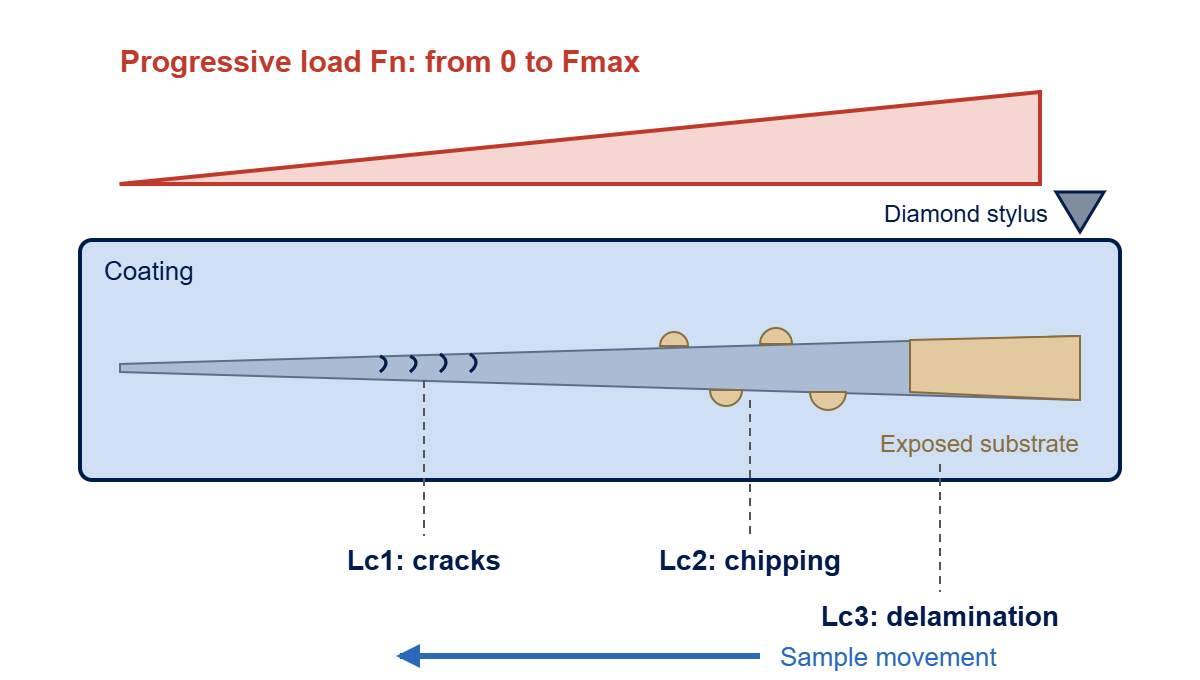
The higher these loads, the better the coating performs. To compare results, however, the test conditions must remain the same: stylus type, loading rate, sliding speed and substrate material.
How is damage detected?
Microscope observation remains the reference method for identifying critical loads. Depending on the instrument, it can be complemented by recording the friction force, the penetration depth or the acoustic emission, whose variations often accompany the onset of damage. What matters is being able to correlate each image of the scratch unambiguously with the corresponding load.
This is exactly what the Smart Scratch Display software of the Scratch Tester Millennium does: it displays and stores images of the various critical loads directly on the loading graph, at the exact position where they were taken. Interpretation is faster, and the test report is clearer.
Scratch test standards
Several standards govern the method and ensure that results are comparable:
- ISO 20502 (formerly EN 1071-3): determination of the adhesion of ceramic coatings by scratch testing;
- ASTM C1624: adhesion strength and mechanical failure modes of thin, hard ceramic coatings;
- ASTM G171: scratch hardness of materials.
Regular calibration of the instrument, for both force and sliding speed, is essential to remain compliant with these standards. A calibration kit that the operator can use simplifies this step.
Macro or milli scratch test: which load range?
The load to apply depends on the thickness and hardness of the coating:
- for hard coatings from 1 to 100 µm (PVD, CVD, DLC, nitrides, carbides), a macro scratch tester working up to 50, 100 or 200 N, such as the Scratch Tester Millennium;
- for very thin films, polymers, varnishes or touch screens, a milli scratch tester working at very low loads, such as the Milli Scratch Tester Premium, from 0.001 to 1 N.
A maximum load that is too high destroys the coating at the very start of the scratch; one that is too low never reaches the critical loads. Choosing the right range is therefore key to the quality of the measurement.
Scratch test applications
Scratch testing is used in many sectors:
- coated cutting and forming tools;
- automotive and aerospace mechanical parts;
- medical implants and devices;
- ophthalmic lenses and optical coatings;
- paints, varnishes and polymer films;
- touch screens and semiconductors.
Scratch test, Rockwell test and calotest
The scratch test is often combined with two other tests. The Rockwell C adhesion test (VDI 3198) gives a quick, qualitative assessment of the adhesion of PVD coatings through a simple indentation. The calotest measures coating thickness, a value that is essential for interpreting critical loads correctly.
Choosing the right scratch tester
Before investing, check the load range suited to your coatings, the quality of the observation system, the software's ability to link images and loads, compliance with standards and ease of calibration. Protecting the equipment matters too: the anti-collision system of the Scratch Tester Millennium safeguards the force sensor, the diamond stylus and the microscope objective during every test.
Would you like to test your samples first? Our laboratory testing service carries out your scratch tests. Request the technical documentation or contact our experts.
Article written by Marc Bellantonio, founder of TRIBOtechnic and a tribology specialist for more than 35 years.